

Next week, 3GPP’s architecture group (SA2) meets in Calgary with a deadline: settle the overall 6G System architecture by the end of SA2#178, November 16–20. After more than a year of study, the 6G Core draft has 24 key issues and dozens of competing solutions. The headline fight is about AI and agents, but the decision that matters most is quieter: how much of the 6G Core is new. What SA2 decides will shape Release 21, the first release of 6G specifications; Release 20 is the 5G-Advanced bridge to it.
My recommendation fits in three words: simple, cheap, fast. Operators are still paying for 5G standalone, and many are still looking for the return on it. The 6G Core should be the cheapest, quickest path to 6G service, not a second rebuild.
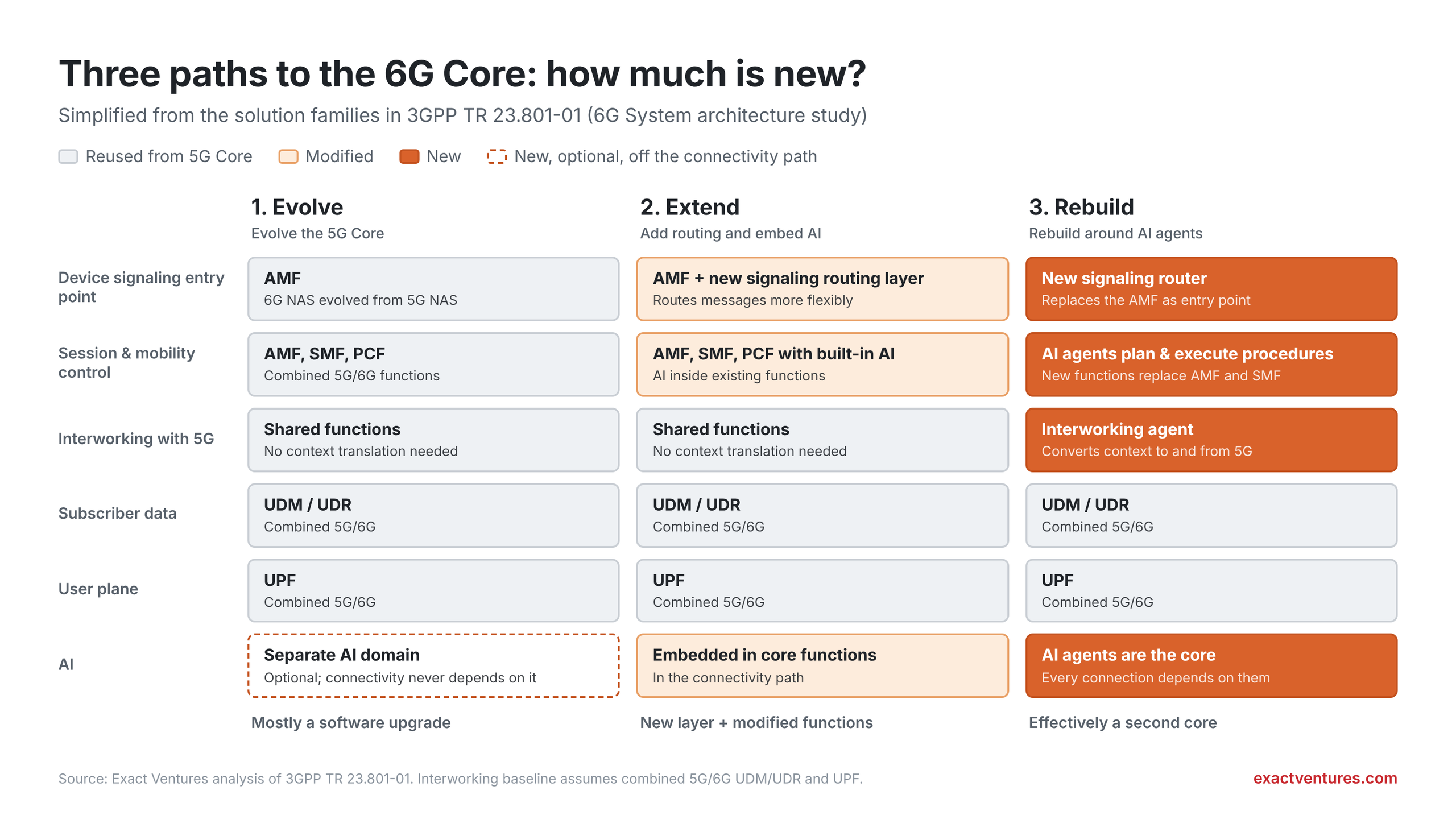
Strip away the acronyms and the 6G Core study offers three broad paths:
The attraction of the agent-native approach is understandable: translate customer intent into services, automate coordination across network functions, and reduce the manual work involved in launching and operating those services. Those are worthwhile goals. But Calgary should distinguish the value of those capabilities from the case for replacing the underlying connectivity architecture. Proponents should show which benefits require a new core and which can be delivered through an optional AI layer over an evolved one.
All three are technically credible, and each has serious backers. The question for Calgary is not which is most ambitious. It is which one operators can afford to deploy, and how soon.
5G left the industry with too many ways to do the same thing: non-standalone and standalone, multiple communication models for service discovery, several redundancy schemes, and a core spec loose enough that most operators ended up with a single vendor anyway. 3GPP knows this. The 6G study’s own introduction commits to “lean and streamlined standards” and to minimizing multiple options for the same functionality.
Calgary is the test of that promise. Simple means one baseline architecture, not a menu of competing approaches. Essential connectivity should work independently of AI, and architectural changes should demonstrate benefits that justify their migration and integration costs. On that basis, retaining an evolved AMF as the single entry point for device signaling should be the default. A replacement should earn its place by solving a problem that evolution cannot address economically—not simply by offering a different way to route messages. New network functions should support genuinely new capabilities, with AI kept outside the essential connectivity path. Every additional function and architectural option brings an integration burden that operators ultimately pay.
Simple also protects something more basic: predictable, testable operation. Registration, session management, charging, emergency calls and lawful intercept should follow explicit rules, with bounded behavior and an auditable record of decisions. AI should not weaken those requirements. Before an agent can control essential connectivity procedures, its proponents should demonstrate that its actions stay within defined limits, that failures can be diagnosed, and that connectivity continues safely when the agent is unavailable or produces an invalid action. AI that recommends, optimizes and predicts can add real value. Making essential connectivity depend on it creates an additional burden of proof—one that should be met before deployment, not left for operators to resolve.
Operators are saying the same thing. A Calgary contribution co-signed by 18 companies, including AT&T, T-Mobile US, Verizon, Deutsche Telekom, BT, Orange, Vodafone, NTT DOCOMO, Telstra and Nokia (S2-2612277), proposes that essential connectivity does not depend on AI. Security agencies have weighed in too. In a separate contribution (S2-2611681), the UK’s NCSC, Germany’s BSI, the US NSA and the UK’s National Physical Laboratory call embedding agents within critical network functions “an unacceptable level of risk,” and ask SA2 to ensure core network functions can be isolated from agents and operate in their absence. When the operators who will deploy 6G and the agencies who will scrutinize it reach the same conclusion, SA2 should listen.
To be clear, cheap is not a comment on quality. It means economically easy: an architecture operators can adopt that minimizes incremental investment and emphasizes the reuse of currently deployed (5G SA) network functions and infrastructure.
The good news is that the draft’s interworking baseline already leans the right way. It assumes a combined 5G/6G subscriber database (UDM/UDR) and user plane, and most contributions favor a combined 5G/6G SMF. Under that model, much of the early 6G Core is an upgrade to functions operators already own. One variant goes further and treats 6G radio as just another radio type under an evolved 5G Core, with a single combined AMF. That is the path operators keep asking for: connect 6G radio to the core they have, then upgrade incrementally.
The agent-native path breaks that. It introduces a new signaling router, new agent functions, and new functions that replace the AMF and SMF, with an agent translating context between 5G and 6G. That is effectively a second core running beside the first, with its own integration, testing, security review and lawful-intercept work. Before 3GPP commits operators to that, someone should price it. I have not seen anyone do it.
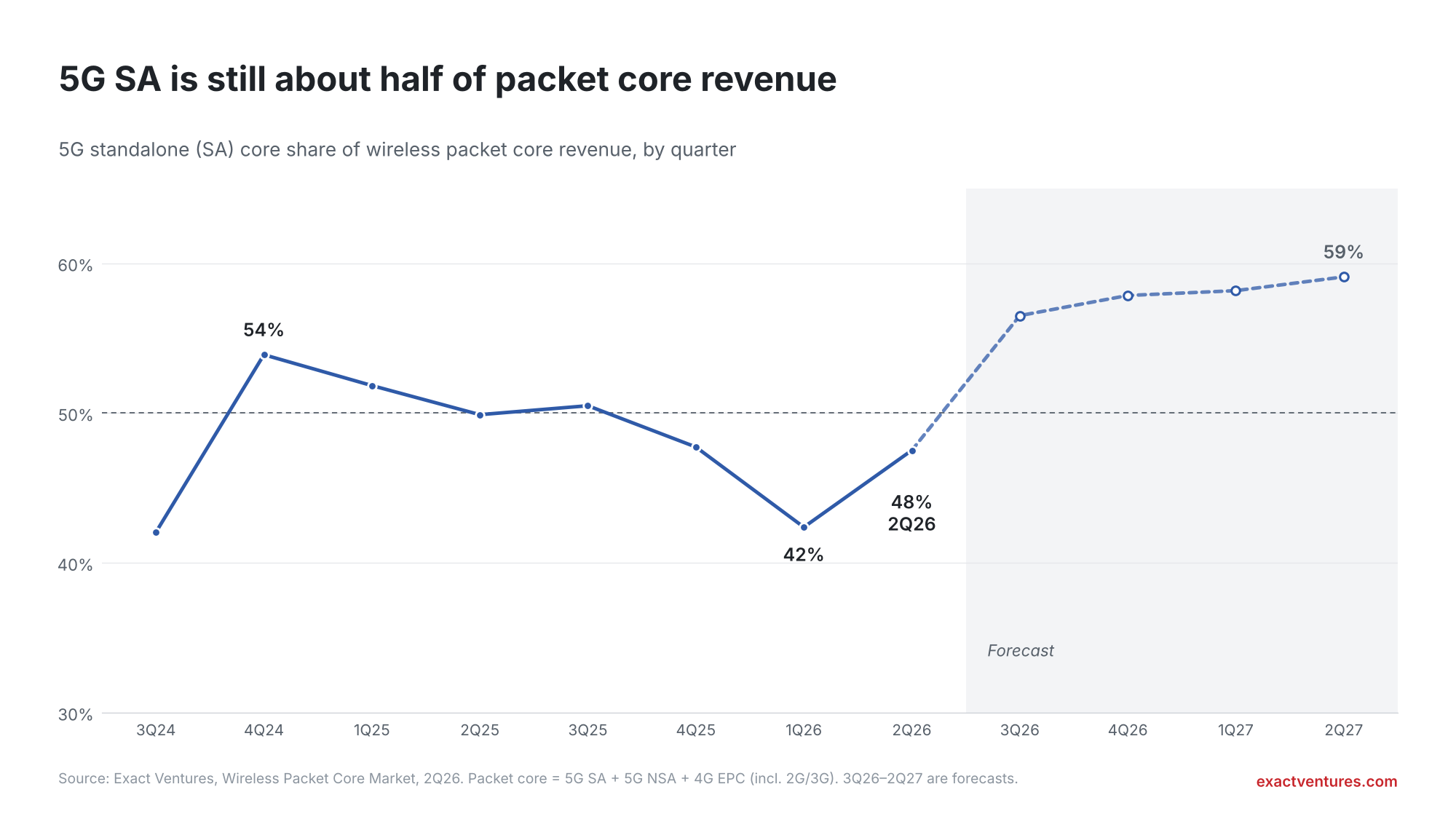
It would also land on an industry that has not finished the last transition. The move to cloud-native network functions has been slow: most operators are still part-way through re-platforming their 5G Cores, and many cloud-native deployments still depend on a single vendor’s stack. Exact Ventures’ research shows how gradual the shift has been: in 2Q 2026, more than eight years after 3GPP completed the first 5G standalone specifications, 5G SA still accounted for just under half of packet core sales, in a quarter that came close to a record. Voice is further behind. And the transition is now getting more expensive: the massive datacenter buildout for AI is driving up the cost of the servers, memory and facilities that cloud-native cores run on, and some operators are extending the life of their physical and virtual voice systems rather than move to cloud-native platforms now. Asking operators to fund a second, architecturally different core while those costs climb is a hard sell.
Cheap also applies to the protocols. HTTP/3 and QUIC are being re-evaluated for the core, which is reasonable. But any change should let 5G and 6G functions talk to each other directly, without protocol gateways in between.
5G standalone took years longer than planned, and native voice over 5G (VoNR) arrived later still. Operators launched with voice falling back to LTE and spent years closing the gap. The 6G draft is unusually candid about why. Its voice section lists the causes of late VoLTE and VoNR: patchy new-radio coverage, missing handover functions in the new core, lawful-intercept equipment that could not handle 5G’s longer cell IDs, and the cost of rolling out many new user plane functions with charging and LI support.
The draft’s proposed cure is telling: use the same AMF and SMF for 5G and 6G, keep 5G’s cell-ID length, and anchor 6G voice sessions on the existing 5G user plane. In other words, the fastest path to 6G voice runs straight through the evolutionary architecture. Every new function on the signaling path is another item to build, test and certify before an operator can switch on voice, emergency calls and lawful intercept.
Fast also means deciding on time. A deadline that slips from Calgary into 2027 squeezes the normative work that follows and pushes commercial 6G Core availability later.
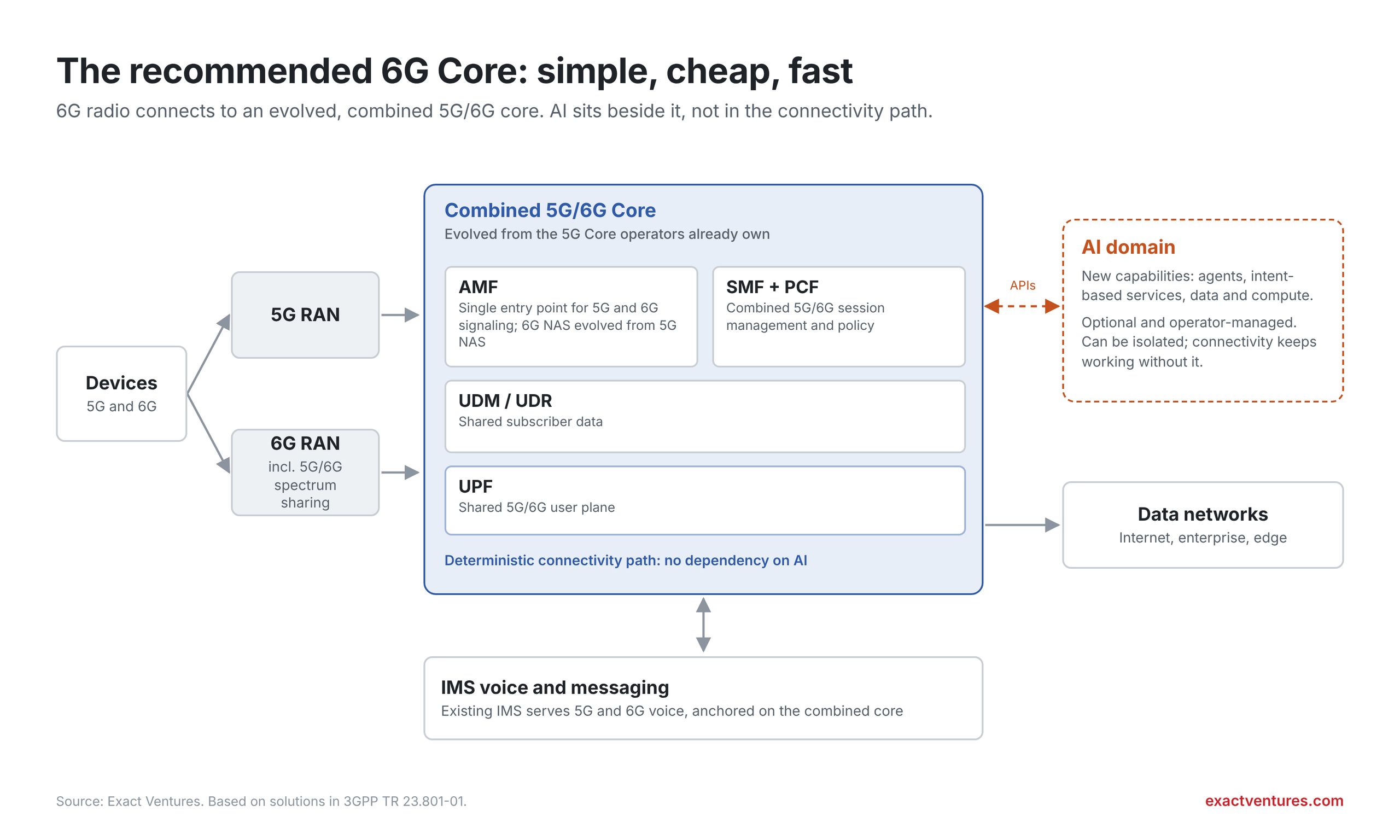
None of this rules out AI in the 6G Core. It puts AI where operators can choose it, rather than making every connection depend on it. The agent-driven ideas in the study are interesting, and some may well earn their place in later releases. But the first release of the 6G Core has one job: give operators a low-cost, low-risk path from the 5G Core they have already paid for to the 6G service their customers will expect.
I will be watching what comes out of Calgary and SA2’s report to the 3GPP plenaries in Boston in December, and I will follow up with what was decided and what it means for the core network market.
Greg Collins is Founder and Principal Analyst at Exact Ventures, a telecom market intelligence firm.
Get in touch