

Like many in the technology space, I have begun to experiment with #OpenClaw, the open-source AI agent framework. As I began setting it up on an old MacBook, (A new Mac Mini is backordered well into the summer) I started to notice the similarities between OpenClaw’s self-hosted compute model and the architecture decisions being made right now at telecoms. These are choices that will only accelerate as AI proliferates and agents are deployed as vital assistants, and eventually embedded in physical devices like robots and drones.
What struck me most is that neither domain borrowed from the other. OpenClaw was built to solve a personal AI problem: how do you give an agent real capability without surrendering your data and control to a cloud provider? Telecom cloud strategy evolved from decades of operational experience: network functions are too latency-sensitive, too regulatorily constrained, and too security-critical to hand off wholesale to a third party. Both arrived at the same answer independently: self-operated infrastructure for the critical, cloud for the routine. That convergence is the point. When two very different domains solve different problems and land on the same architecture, it suggests the underlying logic is sound.
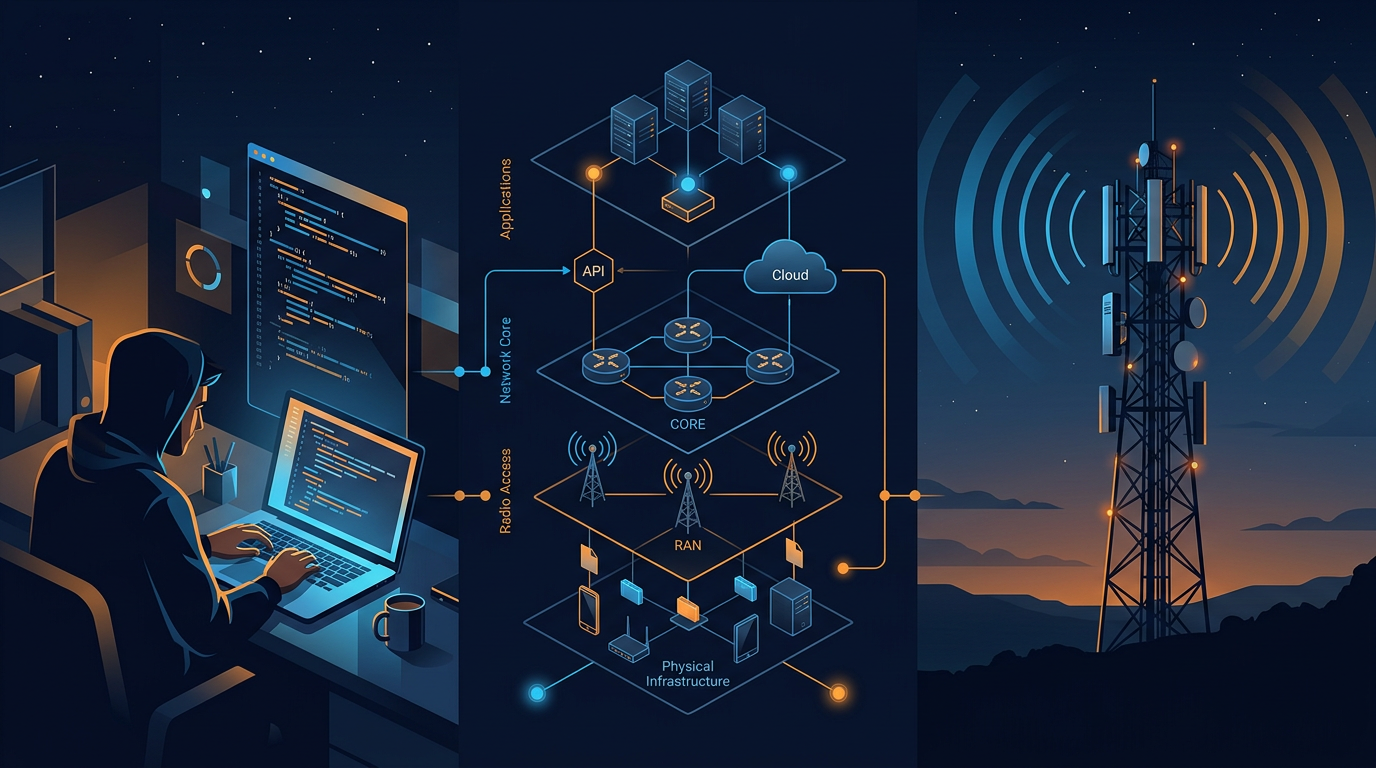
OpenClaw, the open-source AI agent framework that first appeared in November 2025, is built around a deliberate “self-hosted-first” architecture: the agent runs as a persistent daemon on user-controlled hardware, with cloud models serving as optional fallbacks rather than the default execution environment. This design philosophy, which prioritizes local control, data sovereignty, and hybrid flexibility, maps with striking precision onto the challenges telecom operators face when deciding whether to host network workloads on hyperscaler cloud platforms. The two systems didn’t influence each other; they converged independently on the same architectural logic. That convergence illuminates why telecom’s migration to public cloud has been slower than expected, where hybrid models make sense, and what architectural principles should guide future decisions.
OpenClaw’s guiding principle is that control stays with the user. The agent runs as a single Gateway daemon on the user’s own machine (a laptop, home server, or dedicated device) rather than on a cloud service. API keys, files, and system access remain under local ownership. As one architectural analysis put it: “the bottleneck in AI adoption isn’t model capability. It’s trust and control.”
The system treats the LLM as a replaceable intelligence layer, not the platform itself. The Gateway functions as a unified control plane for sessions, channels, tools, and events, keeping each component independent so that switching models or providers requires changes only at the inference layer. This modularity is central to the self-hosted promise.
OpenClaw does not mandate an all-or-nothing approach. Its configuration supports a “local primary, cloud fallback” model where a local model handles most tasks and a hosted model (such as Claude or GPT) activates only when the local model is unavailable or a task exceeds its capabilities. Community roadmap proposals have formalized this further, routing simple tasks to a fast local model and reserving cloud inference for complex reasoning.
This hybrid approach reduces cloud token costs significantly. Running agent reasoning locally (document understanding, summarization, planning) reduces both the size and frequency of cloud API requests. The local machine handles the routine; the cloud handles the exceptional.
The self-hosted design sidesteps entire categories of compliance concerns. No data processing agreement. No SOC 2 questionnaire. No vendor lock-in. The agent runs on infrastructure you already control. For use cases involving sensitive data (credentials, personal files, internal communications) local execution eliminates the need to transmit data to third-party servers at all.
Telecom operators have progressively moved IT workloads (BSS, billing, analytics, CRM) to public cloud platforms over the past decade. These are standard enterprise applications where hyperscalers offer clear cost and agility advantages: elastic scalability, automated backups, and reduced hardware procurement cycles.
Network workloads tell a different story. Despite years of industry enthusiasm for cloud-native network functions, the 5G core and RAN have proved far more resistant to hyperscaler migration than originally projected.
Several factors explain this reluctance:
The industry consensus is increasingly that the future is hybrid. BSS, analytics, and AI training workloads fit naturally in hyperscaler clouds. Demanding network workloads, particularly RAN and latency-sensitive user-plane functions, will remain on private telco cloud or edge infrastructure for the foreseeable future. Control plane functions occupy a middle ground, where sovereign cloud partnerships may offer a viable path.
OpenClaw’s rapid adoption demonstrates that a key barrier to cloud adoption is not technical capability but trust and control. Telecoms face an identical dynamic. Operators resist moving network functions to hyperscalers not because the cloud cannot run containers or Kubernetes, but because ceding operational control of the core network to a third party introduces dependencies that regulators, boards, and engineering teams find unacceptable, especially when that commitment can be withdrawn.
Microsoft‘s significant rollback of Azure for Operators is instructive. The company halted previews of Azure Operator 5G Core and Azure Operator Call Protection and reabsorbed Nexus teams into Azure Edge and Platform. Hyperscaler investment in the telco vertical is a strategic choice, not a structural commitment. It can and does reverse when more profitable opportunities emerge.
Just as OpenClaw users want their AI agent on infrastructure they already control, telcos want their most critical network functions on infrastructure where they set the rules. The lesson: cloud migration strategies that foreground operational sovereignty, not just cost savings, are more likely to gain organizational commitment.
OpenClaw’s model, where local handles the routine and cloud handles the exceptional, maps directly to the emerging telecom pattern:
Workload Type OpenClaw Equivalent Recommended Hosting Rationale BSS, billing, CRM Simple routing and formatting tasks Hyperscaler public cloud Cost efficiency, elastic scaling AI/ML training, analytics Complex reasoning tasks Hyperscaler or sovereign cloud GPU access, burst capacity 5G core control plane Security-critical agent actions Sovereign/private cloud Data sovereignty, regulatory compliance RAN, user plane, MEC Local shell execution, browser control On-premises / telco edge Latency, deterministic performance
The key principle is the same in both cases: define clear boundaries between tiers based on sensitivity, latency, and control requirements, rather than pursuing a blanket “cloud-first” or “on-prem-only” strategy.
OpenClaw explicitly avoids lock-in to any single LLM provider. Its architecture supports model-agnostic routing, multiple API providers, and community-authored integrations. No single vendor failure brings down the system.
Telecoms face the same structural risk with hyperscalers. Security tools, API conventions, and service meshes differ across Amazon Web Services (AWS), Azure, and Google Cloud and others. A Google Cloud specialist is not an AWS specialist; migrating between providers requires reconfiguring both data pipelines and codebases. The Azure for Operators episode demonstrates that hyperscaler commitment to the telco vertical can evaporate when strategic priorities shift. The lesson: architect for portability from day one, using open standards — Kubernetes, cloud-native NFs, standardized APIs — rather than proprietary hyperscaler services wherever possible.
OpenClaw’s security model is layered: identity-based pairing, per-agent tool allowlists, and optional container sandboxing with restricted network egress by default. Critically, the project acknowledges that prompt injection remains an unsolved problem. The security model provides defense-in-depth, not a silver bullet.
The parallel for telecom is direct. Hyperscalers provide robust infrastructure security (encryption, access management, network segmentation) but their tooling is not designed for 5G-specific threats: rogue network function registration, SBI exploitation, or legacy signaling attacks on SS7 and Diameter. These are not generic cloud security problems; they require domain-specific controls that no hyperscaler has productized at the network function layer.
Telco operators cannot outsource security to the cloud provider. They must layer telco-specific controls on top of hyperscaler infrastructure, just as OpenClaw layers application-level security on top of the operating system.
OpenClaw treats data sovereignty as foundational. Data never leaves the user’s machine unless explicitly configured to do so. This design makes compliance with any privacy regime straightforward because the architecture eliminates the exposure by default rather than papering over it with contractual controls.
For telcos, this argues that sovereign cloud partnerships — where a domestic provider offers cloud agility under local jurisdictional control — are not a niche concern but a strategic imperative. Sovereignty cannot be retrofitted; it must be designed in.
OpenClaw’s utility comes from running on the user’s machine. It can read local files, execute shell commands, reach localhost services, and control browser sessions using existing authenticated state. This proximity to the user’s environment is what makes the agent genuinely powerful, in ways a remote cloud service cannot replicate regardless of bandwidth.
For telecoms, proximity to the end user is similarly irreplaceable. Access networks, towers, metro central offices, and regional points of presence are physical assets that hyperscalers cannot easily replicate. Ultra-low-latency 5G use cases (autonomous mobility, industrial automation, real-time closed-loop analytics) require compute within close geographic range. Edge compute distributed for coverage rather than efficiency will run at lower utilization than hyperscaler data centers, but that distributed presence is a competitive asset, not a liability. It is the telco’s structural moat.
OpenClaw’s trajectory, from a November 2025 side project to one of the fastest-growing repositories in GitHub history, signals a broader shift in how infrastructure is designed. The centralized cloud model that dominated for a decade is fragmenting under pressure from AI inference demands, data sovereignty regulations, and latency requirements that physics cannot negotiate away.
Telecom operators are well-positioned in this shift. They own the physical proximity, the licensed spectrum, and the regulatory relationships that make distributed, sovereign, edge-first architectures viable at scale. The OpenClaw model, with its self-hosted execution with cloud as a flexible fallback, modular design that prevents vendor lock-in, and layered security from identity through isolation, offers a practical conceptual framework for how telecoms should approach their own hybrid cloud decisions.
The question for telecom is no longer whether to use hyperscalers, but for what. OpenClaw’s answer is routine, lower-sensitivity workloads where relinquishing some control is an acceptable trade. That is the same answer the telecom industry is converging on. The network core, the control plane, and the edge belong on infrastructure the operator controls. Everything else can flex to the cloud.
The fact that a personal AI agent framework and a global telecommunications industry arrived at that answer independently, solving entirely different problems, should give telecom strategists some confidence. It isn’t a fashionable architectural preference. It’s the answer that physics, regulation, and operational reality keep forcing, regardless of where you start.
Get in touch